What Does Each Instrument Do? Bass, Drums, Chords and Lead
Cihad Turhan6 min read
In most songs, each instrument does one of four jobs: the drums keep time, the bass anchors the harmony and locks to the kick drum, the chords fill in the middle and set the mood, and the lead carries the melody you remember. A fifth group, often called ear candy, adds small details such as hi-hats, arpeggios and effects that make the track feel alive without competing for attention.
Once you know those jobs, a dense mix stops sounding like a wall of noise. You can pick out each part, understand why it is there, and hear what changes when one drops out. This guide walks through each role, gives you a listening test for it, and ends with an exercise that isolates the layers one at a time.
The four jobs (plus one)
| Role | Typical instruments | What it does | What you lose without it |
|---|---|---|---|
| Rhythm | Kick, snare, hi-hats, percussion | Marks the beat and the groove | The pulse; the song floats |
| Bass | Bass guitar, synth bass, piano left hand | Plays the root of each chord, ties harmony to rhythm | Weight; chords sound thin and unsure |
| Harmony | Chords on keys, guitar, pads, strings | Fills the middle, sets major or minor mood | Color; the melody sounds bare |
| Melody | Voice, lead synth, piano right hand, solo instrument | The tune you hum back | The hook; the song has no identity |
| Ear candy | Shakers, arpeggios, plucks, risers | Movement and detail between the main parts | Polish; the track feels static |
Drums and bass together are often called the rhythm section. They work as a unit: the bass usually lands on or near the kick drum, so the low end feels like one instrument.
Each role, with a listening test
Drums: the clock
The drums answer one question: where is the beat? In a lot of pop and dance music, the kick lands on beats 1 and 3 (or every beat, in house), the snare or clap lands on 2 and 4, and the hi-hats subdivide the gaps.
Listening test: tap your foot to any song. Your foot is almost certainly following the kick. Now clap on the snare. If you can do both, you have found the backbone. Then listen above them for the hi-hats, which are the fastest, highest ticking sound in the mix.
Bass: the floor
The bass usually plays the lowest note of each chord, called the root. That single note tells your ear which chord you are hearing, even when the chord instruments are quiet. It also carries rhythm, because it moves with the drums.
The bass is the part beginners miss most, because small speakers and phone speakers barely reproduce it.
Listening test: use headphones. When the harmony changes, hum the lowest pitch you can hear. If your hum moves when the chords move, you are following the bass line.
Chords and pads: the color
Chord instruments play several notes at once to fill the space between the bass and the melody. Their main job is mood: the same melody over a major chord sounds open, and over a minor chord it sounds darker. Pads are long, soft sustained chords common in electronic music; they glue the arrangement together.
Listening test: listen for the part that changes every bar or two but never sticks in your head. That is usually harmony. It supports the tune instead of being the tune.
Lead: the hook
The melody is the line you would whistle on the way home. In vocal songs it is the singer. In instrumentals it might be a lead synth, a piano right hand or a violin. A good arrangement keeps other parts out of the melody's register so it stays clear.
Listening test: after the song ends, hum it. Whatever comes out is the lead.
Ear candy: the details
Arpeggios (chords played one note at a time), shakers, plucks and risers fill gaps and add motion. They are often the first things a producer adds to a loop that feels empty, and the first to be cut when a mix gets crowded. Listen for anything that appears for only a few bars, or that moves quickly in a high register without carrying the tune.
Exercise: isolate the layers one ring at a time
Reading about roles helps, but hearing them separately is what trains your ear. You need a way to hear one part, then two, then three, in a fixed order.
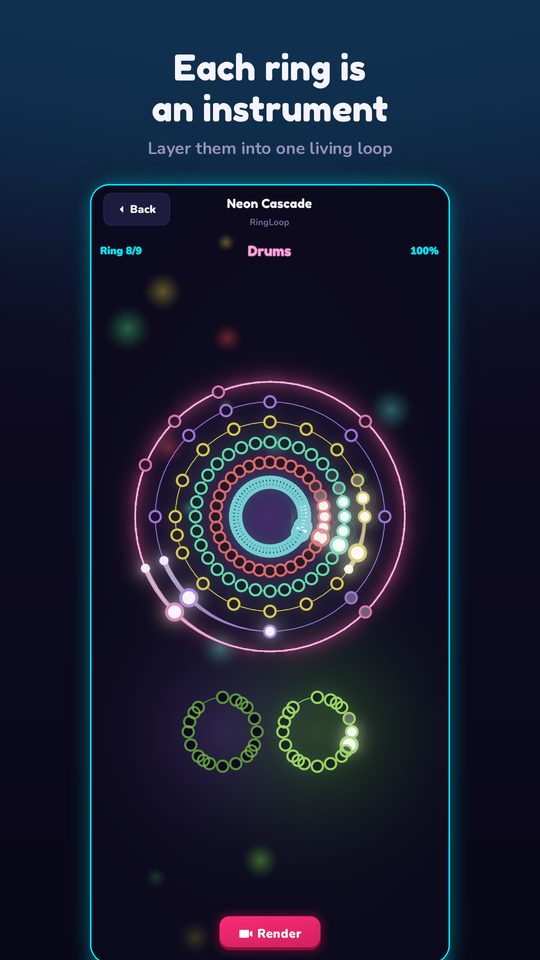
RingLoop is built for that. Every song is a set of concentric rings, and each ring is one instrument. When you clear a ring in time, its instrument joins the mix, like a loop station, until the full song plays. That makes it a step-by-step listening drill:
- Play the first ring and name its job. Is it the clock, the floor, the color, the hook or the detail? Use the table above.
- Clear the next ring and listen for what changed. Did the song gain weight (bass), mood (chords) or identity (melody)?
- Write down the order. Many arrangements start with the rhythm section and save the melody for later, so the payoff lands when the tune arrives.
- Repeat with a different genre. The catalogue includes classical melodies remixed into neon, plus house, lo-fi, synthwave and chiptune originals. Compare which role arrives first in a house track and in a lo-fi one.
To go one step further, import a MIDI file of a piece you know in the level editor. RingLoop creates one ring per MIDI track, so a well-split file gives you one ring for drums, one for bass, one for chords and one for the melody. You can adjust the mix per ring, so turn the bass up while you are learning to hear it, then bring it back down. If a file arrives as a single track, the guide to turning a MIDI file into a looping music video covers getting a usable MIDI into the editor.
Seeing the parts written down is the other half of understanding them. Note Bounce drops bouncing balls onto real sheet music, so you can read a melody as notes and rhythm while you hear it. Pair it with this exercise: hear the lead as one ring in RingLoop, then read what a melody looks like on the staff.
Try it
Pick one song you know well today. Name its drums, bass, chords, lead and ear candy using the listening tests above, then play it layer by layer in RingLoop and check whether you heard each part correctly. Do the same with one song from an unfamiliar genre tomorrow. After a handful of songs, you will start hearing arrangements as separate parts automatically.
Frequently asked questions
- What is the difference between melody and harmony?
- Melody is the single line of notes you would hum or sing back, one note at a time. Harmony is the notes that sound underneath or alongside it at the same time, usually as chords, and it sets the mood of each moment.
- How do I learn to hear the bass line?
- Listen on headphones or speakers with decent low end, and hum the lowest note you can hear each time the chord changes. Start with songs where the bass plays long, simple notes, then move to busier lines once you can follow those.

Get RingLoop
Free to play on iPhone, iPad and Android. Import your MIDI, clear the rings and render the loop as a video.