How to Get Better at Rhythm Games: 8 Practice Habits
Cihad Turhan5 min read
To get better at rhythm games, fix your audio setup first, then train yourself to follow the beat instead of reacting to each note, practice the hardest sections in isolation, and keep sessions short. Most timing problems come from one of those four areas, and none of them need special talent to fix.
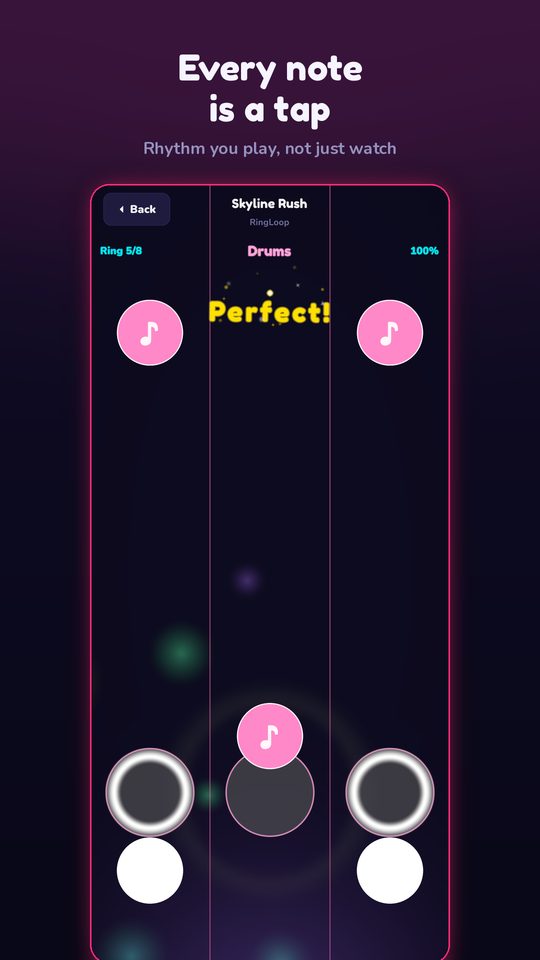
The habits below apply to any rhythm game, from tapping games on your phone to drumming or dance games. Examples use RingLoop, where clearing each ring in time adds its instrument to the song, but the ideas carry over anywhere.
Fix your setup first
1. Check your audio before blaming your timing
If you consistently feel late, your setup may be adding delay. Wireless headphones and some external speakers take a moment to deliver sound, so you hear each note slightly after the game plays it, and every tap lands late as a result.
A quick test: play the same song once with wireless headphones and once with wired ones or your device's built-in speaker. If your accuracy jumps, the setup was the problem. Many rhythm games include an audio offset setting for this reason; if yours has one, use it.
Learn the song and feel the beat
2. Listen to the song before you play it
Rhythm games reward knowing what is coming. Before a serious attempt on a new song, listen to it once without trying to score. Notice where the beat is, where the busy passages are, and where the song pauses.
In a layered game this is easy to do part by part: each ring in RingLoop is one instrument, so you can learn each layer as it joins rather than facing the whole mix at once.
3. Tap with the beat, not at the notes
Beginners often wait for each note to arrive and then react. Reaction is always a little late. Strong players feel the pulse and let their taps fall on it, the same way a drummer plays.
Try this drill:
- Pick a song with a clear beat.
- Before playing, tap your foot or nod along for a few bars.
- Keep that motion going while you play, and let your fingers land with it.
When your body is already moving in time, notes on the beat become predictable instead of surprising.
4. Count the hard rhythms
When a pattern keeps beating you, stop and count it. Say "one-and-two-and" out loud while the pattern plays, and notice which syllables the notes fall on. Off-beat notes land on the "and", and fast runs often split each beat into four ("one-e-and-a").
Once you can say the rhythm, you can play it. This works especially well for syncopated parts that feel random until you count them.
Practice in short, focused blocks
5. Isolate the section that breaks you
Replaying a whole song to practice ten seconds wastes most of your time. If a game lets you practice a section, use it. If you build your own levels, make a short practice version.
In RingLoop's level editor you can import a MIDI file, split dense parts across rings, and test-play and tune the difficulty. That lets you build an easier version of a hard passage, get it clean, and then step back up to the original.
6. Practice slow, then speed up
Accuracy at a slow tempo transfers to faster tempos; sloppy speed doesn't. If your game or editor lets you play an easier version, master that first. Musicians use the same approach with a metronome: play it right at a comfortable speed, then raise it gradually.
7. Keep sessions short and stop on a good run
Timing gets worse with fatigue, and practicing mistakes teaches them. Play in short blocks and stop when you notice the same error repeating. Ending on a clean attempt also makes it easier to come back the next day.
RingLoop has no timers, lives or energy, so you can take breaks whenever you like and retry a ring as many times as you need.
8. Record yourself
Watching a recording shows things you can't notice while playing, such as hesitating before a fast section or rushing after a pause. Your phone's built-in screen recorder is enough for this; watch the clip back and note exactly where your timing slips. When you want a polished clip to share instead, RingLoop renders video in portrait or landscape, from 720p up to 4K, saved to your camera roll. For more on that, see the guide to turning a MIDI file into a looping music video.
Train your rhythm reading too
Rhythm games teach your hands; reading rhythm on paper teaches your head. Note Bounce lands bouncing balls on real sheet music, so you see what each rhythm looks like as notation while you play it. Pairing the two helps the counting habit from step 4 stick, because you start to recognize rhythms by sight.
A one-week plan
| Day | Focus |
|---|---|
| 1 | Test your audio setup and pick three songs to work on |
| 2 | Listen to each song once, then play with foot tapping |
| 3 | Find the hardest section in each and count its rhythm aloud |
| 4 | Practice only those sections at an easier setting |
| 5 | Full runs, short session, stop on a clean attempt |
| 6 | Record a run and note where timing slips |
| 7 | Rest, or play something new just for fun |
Repeat the week with harder songs once the first three feel comfortable. Improvement in rhythm games comes from steady, focused practice, and these habits make every session count.
Frequently asked questions
- Why do I keep hitting notes late in rhythm games?
- Often it is the setup, not your hands. Wireless headphones and some speakers add a delay between the game and your ears, so try wired headphones or the device speaker before changing how you play. If you are still late, practice tapping with the beat rather than reacting to each note.
- How long should I practice a rhythm game each day?
- Short, focused sessions usually work better than long ones, because timing gets sloppy when you are tired. Stop when you notice the same mistake repeating and come back later.

Get RingLoop
Free to play on iPhone, iPad and Android. Import your MIDI, clear the rings and render the loop as a video.