Flight of the Bumblebee Challenge: Build the Hardest Ring
Cihad Turhan4 min read
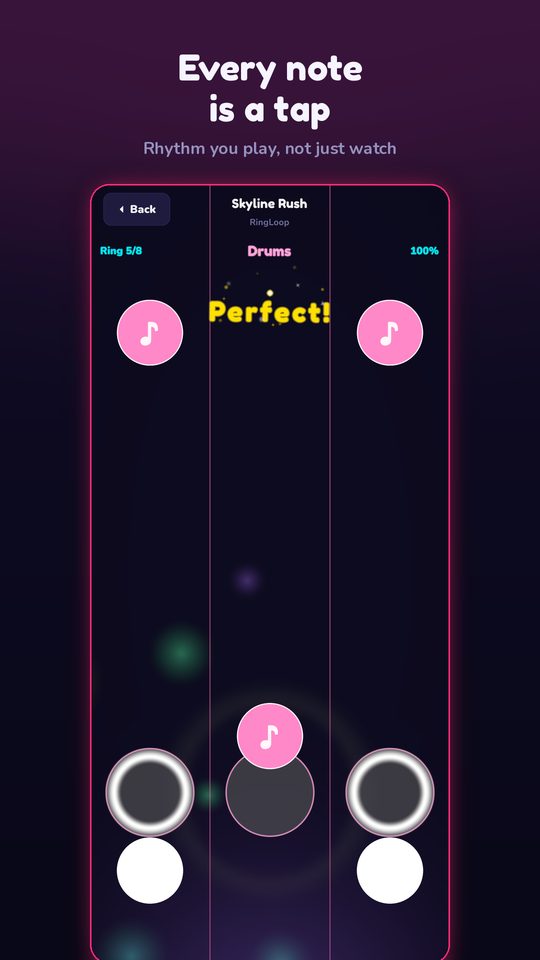
Flight of the Bumblebee is a perfect challenge level because its melody is a nearly nonstop stream of fast, mostly chromatic notes. Import a MIDI of it into RingLoop, give the frantic melody its own ring, tune that ring to be hard but fair, and record your attempts: "can you clear the bumblebee ring?" is a stake anyone understands instantly.
The secret to a good challenge clip is not making it impossible. It's making the difficulty visible and the outcome uncertain.
The piece
According to Wikipedia's article on the piece, Nikolai Rimsky-Korsakov wrote Flight of the Bumblebee as an orchestral interlude for his opera The Tale of Tsar Saltan, composed in 1899 to 1900. In the story, a magic Swan-Bird turns Prince Gvidon into a bumblebee so he can fly off to see his father, and the music imitates the insect's darting, buzzing flight.
It has since become a famous showpiece for soloists on almost every instrument. The composition is in the public domain, and orchestral scores are on IMSLP.
What makes it so hard
- Speed. The melody moves in fast, even notes for long stretches.
- Chromatic lines. Much of it climbs and falls by half steps, the smallest steps in Western music, so there are few familiar patterns to lean on.
- No rest. There are very few pauses, so stamina matters as much as accuracy.
Those are exactly the qualities that make a viewer lean in: they can see and hear how hard it is without knowing any music theory.
Design a fair challenge
A challenge level should be hard in one obvious place, not exhausting everywhere. In RingLoop, every song is a set of concentric rings, and each cleared ring adds its instrument to the mix, like a loop station. That lets you put the difficulty exactly where you want it.
A ring plan:
| Ring | Part | Difficulty |
|---|---|---|
| 1 | Bass and low strings | Easy: sets the tempo |
| 2 | Accompanying chords | Medium: steady rhythm |
| 3 | Bumblebee melody | Hard: the challenge ring |
Building up to the hard ring gives viewers a few seconds of calm before the storm, which makes the final ring more dramatic.
Prepare and tune the level
- Get a MIDI file. The Marble Music MIDI library hosts more than 1,100 free MIDI files, and the Mutopia Project publishes public-domain scores and MIDI. Check the license of the file you choose.
- Trim to a short section. The opening run plus one phrase is plenty for a clip. A full performance is long, and challenge videos work best when they're short.
- Import and check the rings. The level editor creates one ring per MIDI track. If the melody is doubled across several instruments, keep one and merge or remove the rest.
- Tune the difficulty. Use test-play to find the line between hard and impossible. If the melody ring is unplayable, the editor can split it across two rings, which keeps the speed but shares the load.
- Balance the mix per ring so the melody buzzes clearly over the accompaniment.
The guide to turning a MIDI file into a looping music video covers importing and rendering in detail.
Render and caption
This piece suits an "easy mode vs hard mode" pair: render one version with the melody ring split and one unsplit, and post them side by side. RingLoop has no timers, lives or energy, so you can retry the hardest ring as often as you need while you record.
Render in portrait for Shorts, Reels and TikTok, from 720p up to 4K, saved to your camera roll. VIP unlocks larger renders and watermark-free videos. Use the perfect loop option for a clip that repeats seamlessly, or end on the clear for a clean payoff.
Caption ideas that make the stakes obvious:
- "Rimsky-Korsakov wrote this to sound like a bee. It plays like one too."
- "One ring left. It's the bumblebee."
- "Attempt 14. Do I finally clear it?"
Keep claims honest: let the run speak for itself rather than promising viewers they won't believe the ending.
For a different kind of challenge with the same piece, try reading it. Note Bounce lands bouncing balls on real sheet music, and its MIDI import lets you build a level from the same file. A "can I read the bumblebee?" clip, with chromatic runs racing across the staff, pairs naturally with your RingLoop attempt.
Start with three attempts
Build the level, record three attempts on the bumblebee ring today, and post the best and worst side by side. If viewers ask for an easier version, split the melody ring and post that as a follow-up. A hard ring and an honest result are all a challenge video needs.
Frequently asked questions
- Why is Flight of the Bumblebee so hard?
- The melody is a near-continuous stream of fast notes, much of it chromatic, meaning it moves by half steps. There are few pauses, so players need speed, evenness and stamina at the same time.
- Is Flight of the Bumblebee public domain?
- The composition is. Rimsky-Korsakov wrote it for his opera The Tale of Tsar Saltan around 1899 to 1900, and he died in 1908. Specific arrangements, recordings and MIDI files can still have their own licenses.
Get RingLoop
Free to play on iPhone, iPad and Android. Import your MIDI, clear the rings and render the loop as a video.